
A Crete postscript
Revisiting an Australian epic, 85 years ago this week.

They’d been dive-bombed by screaming Stukas, strafed by Messerschmitts, pummelled by Heinkels and Dorniers and Junkers … it appeared Herr Goering had flung the entire Luftwaffe at the beleaguered defenders of Crete.
When the paratroopers came at last, leaping from their low-flying and lumbering transports, the Australians hit back hard to reap a fearful toll.
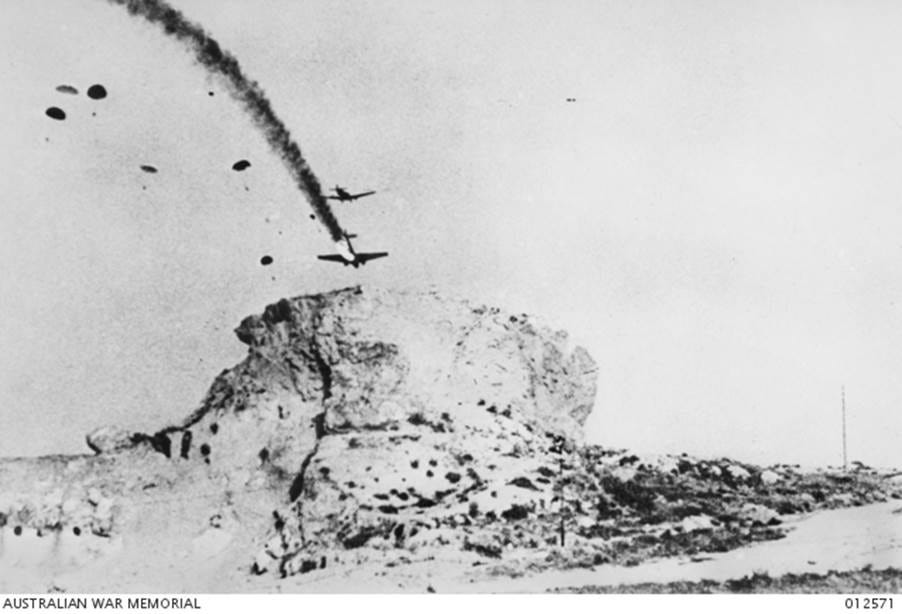
Action over Heraklion: The Germans paid dearly for Crete.
They killed the enemy. They held their ground. They persisted and endured.
When the order came to evacuate, they stole away silently, like their fathers and uncles had at Gallipoli.
Down they filed to the port of Heraklion, onto its jetty and into the waiting destroyers.
They did all this -- only to be killed by British torpedoes.
It happened one night 85 years ago.
When the destroyer HMS Imperial’s steering jammed, the British admiral ordered it scuttled by HMS Hotspur.
“Orders were given on the Imperial to line the side at once and jump from one ship to the other as the Hotspur came level,” acclaimed British historian Antony Beevor wrote.
“A group of Australian soldiers, semi-insensible from drink, had to be left below.
“As soon as everyone capable of jumping was aboard, Hotspur pulled away and fired torpedoes into Imperial, leaving her to sink.
“The Australians left on board went down with her.”
The preceding four sentences are from Beevor’s 1991 book Crete – The Battle and the Resistance.
The unfortunate Australians’ names are not given. There is no source for the story. Who were they? Why did they have to die like this? Were they really “semi-insensible from drink”? Is there more to this tragic postscript to the Crete fiasco?
The starting point is the Australian War Memorial’s Roll of Honour.
The Imperial was sunk in the early morning of May 29, 1941. The Roll of Honour lists 52 Australians dying on that date.
Of those 52, 39 were from units evacuated from Heraklion that night.
Of those, 37 were from the 2/3rd Light Anti-Aircraft Regiment[i], a Victorian Bofors unit. The other two men were from the 2/4th Infantry Battalion, a NSW unit.
They were listed as being ‘killed in action … at sea … Middle East … near Greece … Crete, Greece’.
The roll included Gunners Clarence and Ronald McQuienn. Regimental numbers VX33201 and VX33202. Brothers from Watchem, 35km north of Donald in north-west Victoria.
It’s small comfort for their family, but we know the McQuienn brothers were not “semi-insensible from drink” when they died. Because they were not on the Imperial.
By delving beneath the Roll of Honour, we can discount men from being on the Imperial when it was sunk.
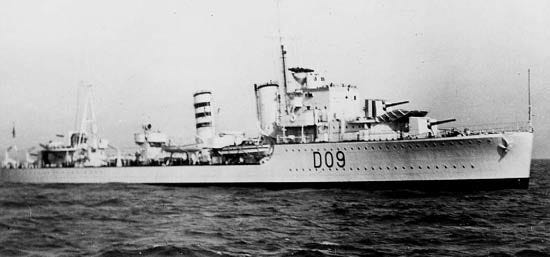
HMS Imperial (uboat.net)
The 2/3rd Light Anti-Aircraft Regiment history On Target places Bathurst Burns, Archibald Moncur and Keith Moodie on the destroyer Hereward when it was hit by a bomb at 6.25am.
Burns and his mate Bill Dellar emerged from below to be confronted with chaos on the deck – abandon ship was the order and then every man for himself. Burns and Dellar instead joined forces – they ripped a door from its hinges to fashion a makeshift raft. When men in the water tried to clamber aboard it was swamped. Burns swam back to the stricken Hereward. And was never seen again.
Dellar took his chances in the water. “I heard another of my mates, Gunner ‘Pud’ Moody (sic, Moodie), say he couldn’t swim and Bombardier Archie Moncur said: ‘Don’t worry I will look after you.’ Unfortunately none of them survived.” Dellar was picked up by an Italian motor boat and survived the war as a PoW.
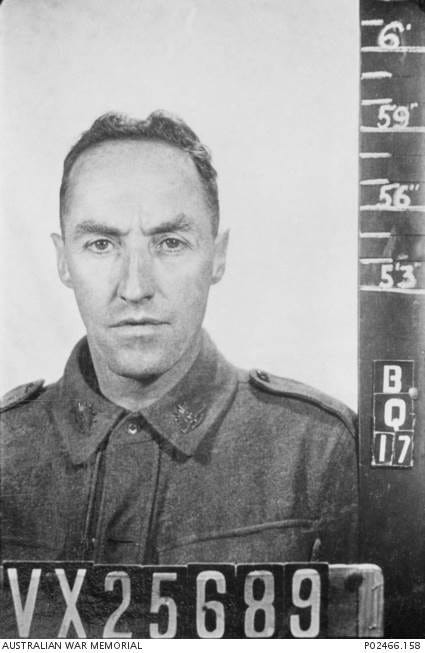
Archie Moncur. Dead at 40.
Gunner Tom Chadwick was giving his mates leg-ups through a manhole to the deck. Eventually it was his turn to go and soon he was in the water. “Cyril O’Meara and Jim ‘Chippie’ Gibson swam nearby, suggesting that we should take our clothes off as it would be easier to swim,” Chadwick said. “Unfortunately, neither Cyril nor Chippie made it.”
Lieutenant Jim Mann, 27, was in the water too, swimming from group to group to rally his men and refusing a place on a lifeboat or raft. Mann is listed as “presumed” dead. He is also an Australian hero.
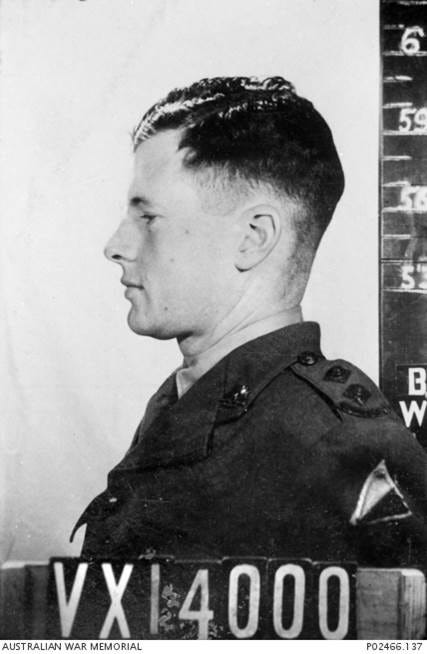
Lieutenant Jim Mann.
According to the regimental history, the 2/3rd men not on Hereward were on the cruisers Dido and Orion – so none of the unit’s 37 men killed that night were on Imperial.
Which leaves two men from the 2/4th Infantry Battalion.
The 2/4th’s history, White Over Green, tells us that one of the two, Private Fred Cockrill, was drowned when Hereward was sunk.
And so one man from the Roll of Honour is unaccounted for, casting doubt on Beevor’s statement that “a group of Australian soldiers … went down with her (Imperial)”.
However, there is a twist in this tale. There were men on the Imperial when it was torpedoed. According to White Over Green, Private Percy Webb woke to find “the ship listing and very quiet”. It appeared he had been missed when the stricken ship was evacuated. Webb was not the only man missed. A sailor had been left aboard too; upon meeting Webb he went below to see if others remained.
“Immediately two torpedoes from Hotspur hit the ship and she commenced to sink. Webb dived over the side and swam 30 yards from the ship before she broke in two and sank.” Utterly alone, he chanced upon a raft and after drifting all day – duck-diving under the raft when enemy planes appeared – he was washed ashore on Crete and captured.
The White Over Green account is silent on the fate of the unknown sailor.
Webb’s story is also included in Craig Collie’s 2023 book Where the flaming hell are we? The story of young Australians and New Zealanders fighting the Nazis in Greece and Crete. Here the story varies slightly from the White Over Green account, in that Collie writes that Webb was sleeping “after an evening’s solid drinking” and had woken after the first torpedo struck.
Collie lists his sources as White Over Green and Before The Tide Turned by Hugh Hodgkinson, an officer aboard Hotspur. Hodgkinson wrote of gangways being run out as bridges between the two ships, so not all men were required to be, in Beevor’s words, ‘capable of jumping’. “Even then they seemed to come over very slowly, for most of them had just dropped off to sleep after a week of hell at Heraklion,” Hodgkinson wrote.
Other accounts add to the picture. The year before he died in 2022 aged 105, venerated veteran of Crete Alf Carpenter was interviewed for an SBS documentary. Carpenter was on the Imperial when its steering jammed. “We had to get on another destroyer which came alongside us and we jumped from one ship to the other. Then when we got away a bit, they put a torpedo into the Imperial.” Nothing about anyone being left aboard.
The British and Australian official histories are silent about drunk Australians being left to die on Imperial. As are the 2/3rd LAA and 2/4th unit diaries. As is British staff officer and author Bernard Fergusson’s account of Black Watch troops transferring from Imperial to Hotspur. “Hotspur came alongside and all ranks, abandoning their rifles, had to jump the gap between the two ships in the darkness,” Fergusson wrote in The Black Watch and the King’s Enemies. “Imperial was then sunk by torpedo.”
Questions abound: If the Australians had been drinking, where did they get the alcohol from? How did they find time to drink – they were fully occupied fighting a war, after all? According to its Unit Diary, the 2/4th began withdrawing to the Heraklion port from 10.50pm on the 28th, and the last of the battalion was embarked by 2.15am. The convoy sailed at 2.30am. Imperial transferred its complement and passengers to Hotspur “about” 4am. She was sunk soon afterwards, Hotspur needing to quickly return to the fold of the convoy’s anti-aircraft screen.
So what to make of Beevor’s account of Australians, “semi-insensible from drink”, being abandoned on Imperial? Leading Australian war historian Peter Stanley is sceptical. “This story is unsourced and unsubstantiated,” Prof Stanley says. “It is highly improbable and implausible, perhaps impossible.”
There is no suggestion Beevor invented the story. But his source remains a mystery.
Beevor’s agent was contacted. He is yet to respond.
With thanks to David McDonald, Keith Morris, Cheryl Peters, the AWM, Peter Stanley and Mark Johnston.
[i] Also rendered as 3rd Light Anti Aircraft Regiment and 3 Light Anti Aircraft Regiment.